
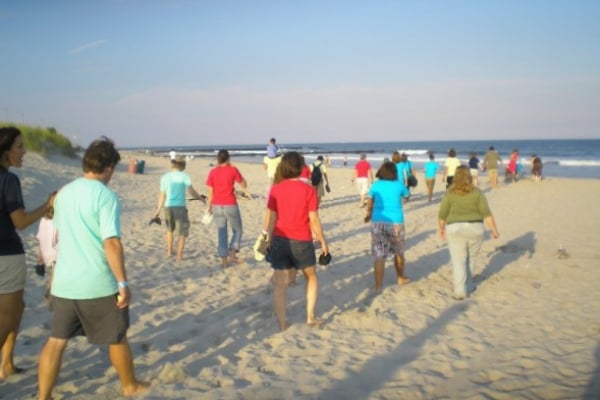
The Beach Project is about to begin
In just a few days, our students and staff will arrive in Ocean City for the Beach Project. For three weeks, they will live, learn, pray, serve, study Scripture, build friendships, practice leadership, and seek to grow together as followers of Jesus.
But the work will not really start with move-in day. In many ways, it has already begun.
Before students ever pack their bags, before the first house meeting, before the first shared meal, before the first Bible study on the beach, we have been asking them to prepare their hearts for the work of ministry.
One of the ways they have been doing that is by working through a study in the book of Nehemiah.
Nehemiah begins not with a building project, but with a burden. He hears about the broken condition of Jerusalem, sits down, weeps, mourns, fasts, and prays before the God of heaven. Before he acts, he sees. Before he leads, he grieves. Before he rebuilds, he prays.
That is the kind of formation we are asking God to do in our students.
This summer, we are blessed to have Abigail, Brandon, Essie, Gabriella, Josh, Kayley, Owen, and Victoria joining us as students.
We are also grateful for the leadership and care of our staff team: Ray Wiesen, Emily Blaker, and Arianna Suggs.
Even before the Beach Project begins, these students are already showing us that God is at work in them.
As they reflected on Nehemiah, students were asked to consider the realities, groups, and struggles on their campuses that they might be prone to overlook. Their answers were honest, thoughtful, and often deeply moving.
Some students began to notice people they had simply not seen clearly before. One reflected on international students on campus: students who often miss home, miss familiar food, face complicated visa realities, and remain separated from other student groups because it is easier and safer to stay with what feels familiar. That student began to wonder what it would look like to help bridge those divides, even in small ways, by inviting students from different cultures and friend groups into relationships.
Another student reflected on how easy it can be, even in ministry, to miss “the one.” Events can go well, chapels can happen, programs can be planned, and yet a student can still miss the small moment of ministry right in front of them. They named a desire to become more present, more attentive, and more available to the people God has placed near them.
Several students named the unique challenges of doing ministry on Christian campuses. They recognized that attending a Christian school does not mean every student is walking with Jesus, rooted in Scripture, or spiritually healthy.
Some students know Christian language but still need guidance, discipleship, and invitation. Others may be hearing the gospel for the first time. Others may look like they are “doing fine” but are quietly disconnected, confused, or spiritually passive.
One student made a list of groups they do not want to overlook: athletes, fraternities, sororities, gym-goers, classmates, quiet students, talkative students, Bible study members who seem okay, and even staff and faculty. That kind of list may seem simple, but it reveals something important.
Students are beginning to see their campuses not merely as places where they attend class, but as mission fields filled with people made in the image of God.
Some responses named campus brokenness with striking clarity. Students wrote about loneliness, broken relationships, peer pressure, party culture, depression, anxiety, quiet hatred, political and social division, racial tension, sexual brokenness, dishonesty in schoolwork, spiritual complacency, and the numbing distraction of phones.
One student lamented how many people seek belonging in things that cannot finally give it. Another confessed how easy it is to prefer comfort over faithfulness, and how often students fail to study, serve, and live wholeheartedly before Christ.
These are not abstract answers. These are students learning to look at their campuses with the eyes of Christ.
And they are not only learning to see. They are learning to pray.
Students were asked what prayers God was stirring in them through the study. Again, the answers were honest and concrete.
Some felt called to pray for greater unity and connection on campus. Some sensed a need to pray more for leaders and staff, not only for students. Some were moved to pray for friends by name. Others were challenged to pray more specifically for particular groups of people rather than only praying in broad, general ways.
One student wrote out a prayer that moved through brokenness, confession, lament, and intercession. They named the ways students seek fulfillment in futile things. They confessed the pull of partying, sexual gratification, and the desire for belonging. They lamented how hard repentance can feel and how costly it can be to follow Jesus when it means losing the approval of others.
But then they prayed with hope, asking God to draw near to those trapped in sin, to bless their campus ministry, to sanctify the leaders, and to make them a light in a dark place.
That is the kind of prayer that grows out of real spiritual formation.
The students were also asked to consider one specific step of faithful risk God might be calling them to take this fall. Not all of the answers were dramatic, but they were meaningful.
One student said their step forward may actually be to step back. They recognized a tendency to keep their hands in everything, to help, to control, and to carry what is not theirs to carry. For them, trusting God may mean releasing control and believing that God’s hand is on the work even when they are not managing every piece of it.
Another student sensed a call to listen more. They named the risk of giving up the space they usually use to talk about themselves, their day, their goals, their concerns, in order to truly hear another person. That may seem small, but it is a deeply Christlike instinct. Ministry often begins when we slow down enough to listen.
Another student reflected on leading an athlete Bible study. Saying yes to that invitation changed how they were seen by teammates. They became known as the “Jesus guy.” That came with questions, skepticism, and some loss of approval.
But it also deepened their faith. They had to learn, in real time, what it means to seek God’s approval more than human approval. They could already see fruit that only God can give.
Finally, one student reflected on the reality that they cannot build alone. After starting a Bible study at home, they realized that the work could not depend only on them. God had given gifts to others too. So they began thinking about friends who could join them in preparing, facilitating, and caring for the group.
That is a beautiful sign of leadership development. Ministry is not merely doing more for God. It is learning to build with others, trust others, and make space for others to lead.
This is what we are already seeing before the Beach Project begins.
Students are learning to see.
They are learning to grieve.
They are learning to confess.
They are learning to pray.
They are learning to take faithful risks.
They are learning that ministry is not something they can do alone.
And this is why the Beach Project matters.
For three weeks, these students will not only receive information. They will be formed. They will be invited to bring their whole lives before the Lord. They will be challenged to consider their campus, their friends, their calling, their gifts, and their next steps.
They will practice rhythms of Scripture, prayer, hospitality, evangelism, leadership, and community. They will learn alongside staff who love them, guide them, challenge them, and point them again and again to Jesus.
Please pray for Abigail, Brandon, Essie, Gabriella, Josh, Kayley, Owen, and Victoria.
Pray also for Ray, Emily, and Arianna as they lead, teach, disciple, and care for these students.
Pray that the Beach Project would not simply be a memorable summer experience, but a holy interruption.
Pray that God would give students eyes to see their campuses clearly, hearts that are willing to enter into the suffering around them, courage to take faithful risks, and humility to build with others.
Pray that they would return to campus not merely with new ideas, but with deeper love for Christ, greater dependence on prayer, stronger courage in witness, and a clearer sense of how God is calling them to serve.
Nehemiah’s work began with a burden. Our prayer is that these students would receive a holy burden, too—for their campuses, for their friends, for the lost, for the lonely, for the spiritually complacent, and for the glory of Christ.
The Beach Project is about to begin.
But God is already at work.
—Kenny Campbell, CCO National Director of Campus Ministry Resources